
The South Atlantic Anomaly (SAA) is a region at the magnetic equator, where Earth’s magnetic field is weaker than usual, allowing charged particles from the sun and space to reach lower altitudes than normal. This weakened magnetic field dips down to an altitude of about 200 kilometers. At an altitude of 500~600 km the SAA centre is approximately above 30oS 50oW.
On Earth Magnets page of this site, I manifested that the magnetic field configuration consists of a) two induced magnetic fields of south polarity, each resides at one geo pole according to Coriolis Effect, and b) one dipole permanent magnet that is emanating from the outer layer of the Inner Core as inspired by research team at the University of Illinois and colleagues at Nanjing University in China.
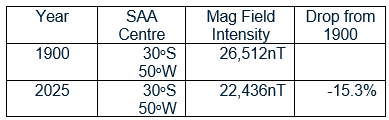
By combining the World Data Center for Geomagnetism, Kyoto to find out the geographical location of the magnetic poles over the years and the US National Geophysical Data Center calculator to find out the magnetic field intensity at the time and location of choice; here is a comparison of the magnetic strength between 1900 and 2025 over the centre of SAA, where the field intensity dropped by 15.3%.
You may refer again to the World Data Center for Geomagnetism, Kyoto to find out the geographical location of the two magnetic poles over the years. It is deducted as per the following table that the two magnetic poles are migrating towards the east simultaneously but at different speed. Such a migration started at slow pace before the year 1900. As such the magnetic field intensity weakens in the west side of the planet, while covering a larger space year after year, leading to the creation of SAA at the mid distance between the two magnetic poles over the Atlantic Ocean and Latin America. The weaker the magnetic field gets there, the larger expansion of the SAA region. The Kyoto data shows that the average speed of the magnetic pole in the Arctic region in the last decade is 6 folds that of the magnetic pole speed in Antarctica. Also, the average speed of the magnetic pole in the Arctic region between 2015 and 2025 has doubled, when compared to the average speed between 1900 and 2015, whereas the speed of the magnetic pole in Antarctica appears to be slowing down in the same period.

Given the higher speed of the magnetic pole at the Arctic, it is apparent that the mid distance between the two magnetic poles will shift towards the north and accordingly SAA preference to expand at its northern imaginary border.
By combining the World Data Center for Geomagnetism, Kyoto to find out the geographical location of the magnetic poles over the years and the US National Geophysical Data Center calculator to find out the magnetic field intensity at the time and location of choice; here is a comparison of the magnetic poles changes in strength between 1900 and 2025.

The drop of the magnetic field strength at the magnetic poles over 125 years by 3.5% in Antarctica and by 5.7% in the Arctic circle, plus the continuous migration of the two magnetic poles towards the East, plus the faster migration speed of the magnetic pole in the Arctic, all lead to the emergence of the SAA region at the magnetic equator in the western hemisphere, its continuous expansion along the years, and preference to expand along its northern border to the extent of crossing the geographical equator.
In 2007 the SAA region appear to be located south to the geographical equator

Source: Oct. 2007: South Atlantic Anomaly as seen by Doris
Recently NASA released a study that shows that the SAA region has expanded to the north, crossing the equator. But why does it split in two regions of minimum magnetic field intensity? Or for better use of words; why the intensity of the magnetic field at the geographical equator of SAA region is higher than at both the northern and southern split regions of the SAA?

Source: NASA finds unknown “X-shaped structures” in Earth’s atmosphere – Earth.com
In the Earth Magnets page of this site I presented the two induced magnetic fields of south polarity when they observed on the surface of Earth following the Coriolis Effect

It is apparent that when two magnetic fields of equal polarity meet at the equatorial plane, they repel one another, and the only way out is to turn along the equatorial plane, exiting at the Earth surface in what we name the geographic equator. Such a pack the emanating magnetic field force of south polarity will be glad to attract equivalent amount of magnetic field force lines emanating from Antarctica. That very well could explain why the drop % of the magnetic field in the Acratic region is -5.7% while in Antarctica is -3.5% . Some magnetic field force lines arriving from Antarctica on route to the North, get hunted at the equator, as they never make their way to reach the magnetic pole in the Arctic.
*******

 Earth Changes