
On March 28th 2016, the Mail Online published an article that is titled Is there really a NINTH planet in our solar system? Scientists say they have even more evidence of mysterious world . Caltech researchers, Konstantin Batygin and Mike Brown have found evidence of a giant planet tracing a bizarre, highly elongated orbit in the outer solar system. According to Caltech, the object, which the researchers have nicknamed Planet Nine, has a mass about 10 times that of Earth and orbits about 20 times farther from the sun on average than does Neptune The article refers to Professor Mike Brown of Caltech, as one of the scientists behind the January 2016 announcement on the 9th Planet. In the January announcement the orbit of the 9th Planet was presented at low eccentric value as follows:

Early February 2016, I sent a message to Konstantin Batygin at Caltech informing of the research I had published back in 2009 and replicated a good deal of it on this website.

In March 2016, Prof. Mike brown at Caltech claimed that he’s found further evidence to support the discovery of the 9th Planet of the solar system. In his tweet, he published the hypothetical orbit of such a planet with a different and higher eccentric value than Caltech earlier paper in January 2016. It showed as per the following sketch, which
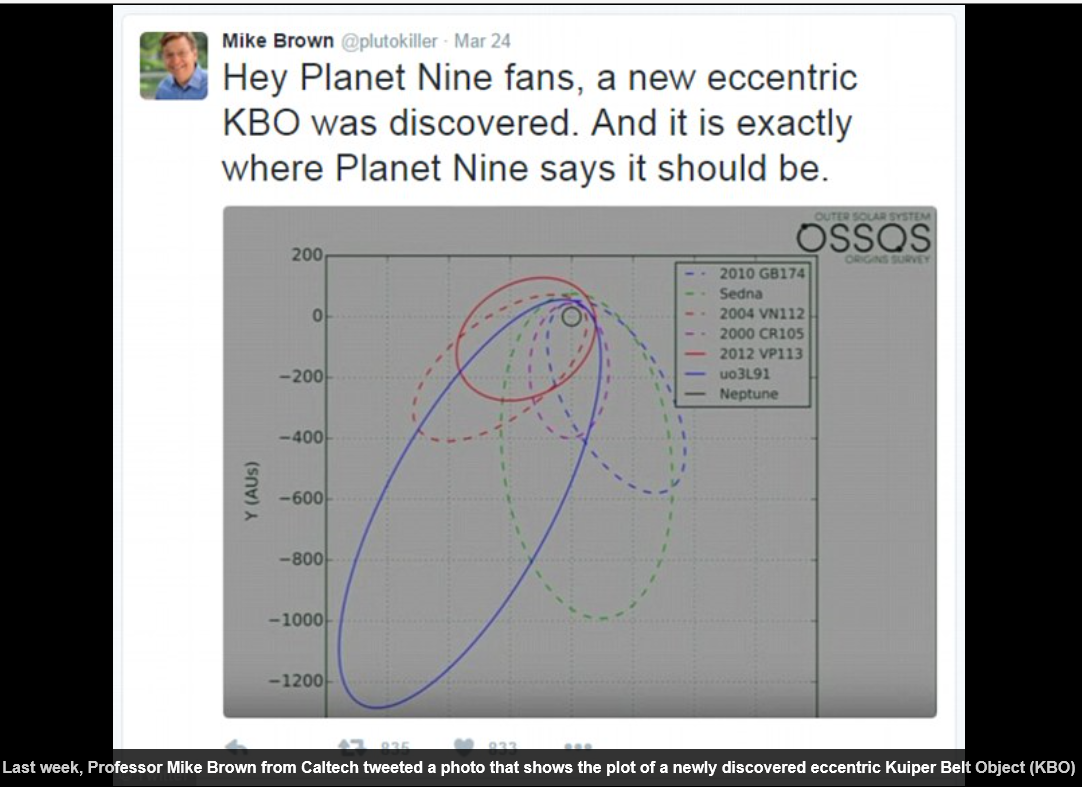 inspired me to wonder about the odds !! Not only has the 9th Planet’s orbit a look alike trajectory of 0.9 eccentricity, to what I published in my book More Than 60 Minutes- When Earth Stands Still, back in 2009 and uploaded on the this site on the internet back in 2012 , but it also enjoys the same 30 degrees angle downward in the same direction relative to the plane of the eight known planets of the inner solar system.

Caltech and I still differ on the orbital cycle. While Caltech scientists estimated 10,000 to 20,000 years an orbit length, my estimation that is based on geological, geo physical and ancient texts precise a 3,562 years duration for the longer part and a 52 years duration for the shorter one going around the Sun. This brings the orbital length to a total of 3,614 years. The double of which is 7,228 years or the Long Count as the Maya called it. The Aztecs believed that a new cycle could be born on a 52-year boundary count. They used to run a grand festival every 52 years in anticipation of the birth of a new Sun. That can only be realized, if Earth stops spinning about its axis for some time and the night grew longer than normal for a couple of days. The Earth Spin page on this site explains in a simple introduction what drives planet Earth to spin about its axis; speed up at times, slow down at times, stop spinning, or reverse spinning.

 Earth Changes
I have a proposed path of Nibiru which is similar. It is based upon 3 to 5 x Earth mass and 3600 year orbit, 30 degrees below Earth ecliptic with outermost part of orbit between Sirius and lowest part of Orion. Near Earth crossing of orbits is with arrival in Pisces and departure crossing in Virgo. When representing these orbital planes on a planisphere, the objects depicted on an ancient fired clay tablet (seven stars, Orion, Taurus, Virgo, Corvus, Hydra, and Leo) all combine to corroborate these two orbit paths and their crossings. In addition, there are depictions in Egyptian art showing a man riding a serpent just as the crossing of Nibiru’s path crosses Serpens Caput and another with a standing man riding the belly of Hydra precisely where Nibiru crossing occurs. The chances of all these things together by accident is a very unlikely occurrence, in my humble opion. Comment please.
Some millennia ago, the Cahto Indians of California told of the Sun, instead of holding its course across the sky, sped crookedly and rushed past like a meteoroid. At that time there was a great darkness, which means a slower spin of the planet (refer to “Earth Spin” page) and that could only mean that the magnetic poles were relocated somewhere closer to the Tropics a result of the inner core whose outer layer is a ferromagnet being pulled the magnetic force of an intruding planet to the inner solar system, and that could have been the nineth planet.
When Caltech researchers, Konstantin Batygin and Mike Brown discovered the planet’s existence through mathematical modeling and computer simulations, the introduced a hypothetical elliptic orbit with higher eccentric value. If we are talking about the same planet, I thought that the elliptic orbit must have a low eccentric value to be able to pass through the inner solar system and cause all the magnetic havoc on its planets including Earth. I communicated my thoughts (refer to “9th planet. What ae the odds” page). Prof Mike Brown later on his tweet updated the orbit by a low eccentric value as I suggested but unfortunately, he forgot to refer to my earlier communication (refer to “9th planet. What ae the odds” page).
It is most likely to have an orbit that is much shorter than the 10,000 years as researched at Caltech. Having research ancient text and geological discoveries, I could see it not far from the acclaimed the planet known as Nibiru whose discovery on the Sumerian tablets remains debatable.
The difficult to detect the 9th planet comes from the fact that it is approaching the inner solar system at bulls’ eye. Unlike other planets when they get detected moving in the face of a star, the 9th planet comes at straight line ‘almost’ to our star. It shall get detected once close enough to reflect the sun light onto its face. Some year back Assistant Prof Konstantin Batygin estimated 2024 to be the year of spotting it. Well, 6 more weeks to go for 2024 to end. Let us see.